.jpg)
Magazine Fire Fighting System

Fleet-Scale Marine Automation — 11 Ships | 88 Panels
Siemens S7-1500 PLC · ET 200SP Distributed I/O · MTP 1500 Unified HMI · TIA Portal

11 Ships Deployed | 77 LCP Panels | 11 DCHQ Panels | 88+ Panels Total |
Scope | PLC programming, HMI development, panel engineering, fabrication, FAT & commissioning |
Technology | Siemens S7-1500 PLC | ET 200SP Distributed I/O | MTP 1500 Unified HMI | TIA Portal | MRP Network |
Industry | Marine / Naval — Safety-critical fire suppression |
Delivery | End-to-end — from engineering brief to fleet-wide commissioning |

Background
Goose Industrial Solutions designed, programmed, fabricated, and commissioned a complete Magazine Fire Fighting System (MFFS) for a fleet of 11 naval vessels — 88 panels total: 11 DCHQ master panels (Siemens S7-1500 + MTP 1500 HMI) and 77 Local Control Panels. One of Goose's largest single-scope automation deliveries.
The Client & Requirement
A global fire suppression integrator needed a complete PLC/HMI package protecting ammunition compartments on naval vessels — seven per ship — operating reliably through humidity, salt air, and intermittent power.
Two panel types per vessel:
DCHQ Panel — master firefighting control centre housing the PLC, HMI, and network master node.
LCP — compartment-level annunciation and manual override at seven locations per ship.
The Challenges
Marine Environment
All junction boxes required thermostat-regulated heater control to prevent condensation, with panel enclosures built to IP ratings for shipboard use.
Network Reliability
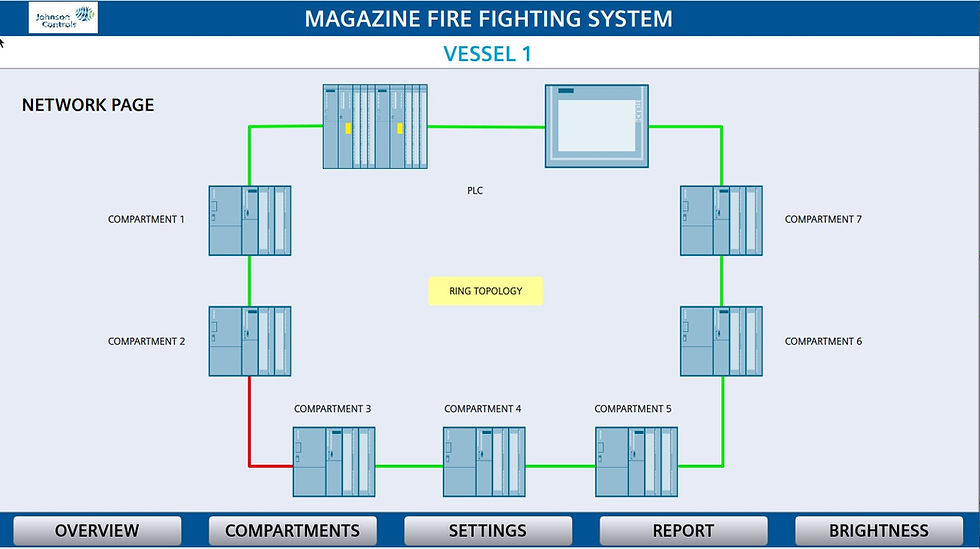
Media Redundancy Protocol (MRP) ring topology was implemented across each vessel; any single cable or switch failure was recovered in under 200 ms.
Safety-Critical Logic
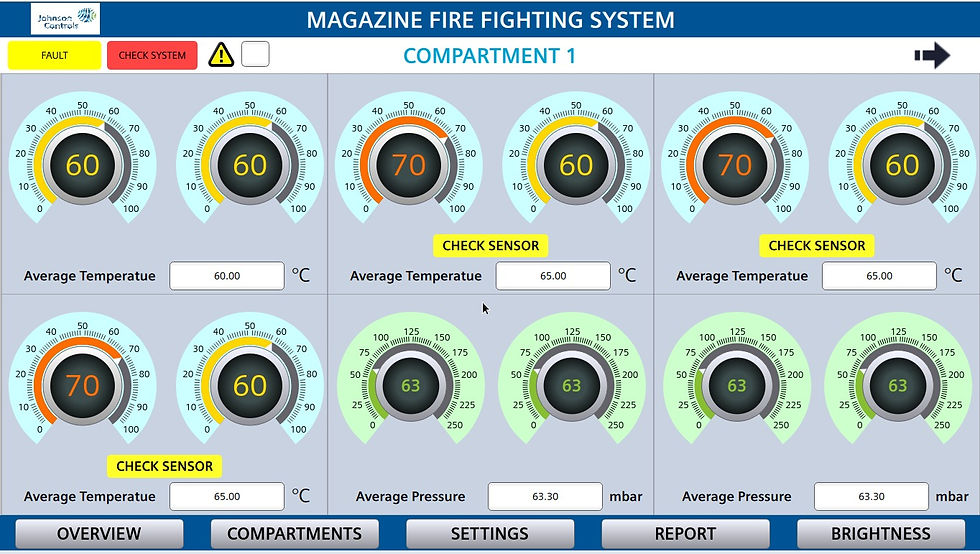
CHECK SENSOR diagnostics prevent false suppression activations: when two sensors in the same compartment diverge beyond a set threshold, the HMI alerts before escalating, stopping a single sensor fault from triggering a full discharge.
Scale & Power Continuity
A single master TIA Portal project with vessel-specific variable tables kept all 88 panels consistent. UPS-backed 24VDC architecture ensured continuous operation through any main power loss.
The Solution Architecture
A three-layer automation architecture, master control, distributed field I/O, and local operator interface; integrated over a redundant Ethernet/IP network.
Layer | Hardware | Function |
Layer 1 — Master | Siemens S7-1500 PLC + MTP 1500 HMI (DCHQ Panel) | Central fire fighting logic, alarm management, QRV sequencing, operator HMI, MRP master, trend & report logging |
Layer 2 — Field I/O | Siemens ET 200SP — AI-1, RTD-1, RTD-2, DI4, DQ5, DQ6 modules | Sensor acquisition (temp, pressure, IR), valve outputs, alarm outputs. One ET 200SP node per compartment JB. Heater control via Panasonic thermostat relay. |
Layer 3 — Local HMI | LCP — Pushbutton panel with indicator lamps (per vessel × 7) | Compartment-level annunciation: TT/PT/IR check, pre-alarm and activated states. Local mode selector, emergency activation, buzzer silence, lamp test. |
HMI Screens
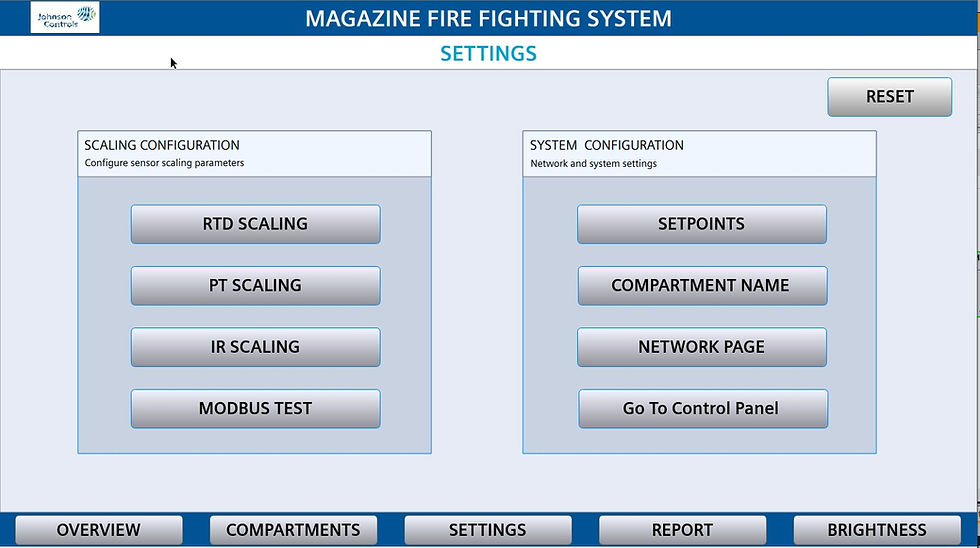
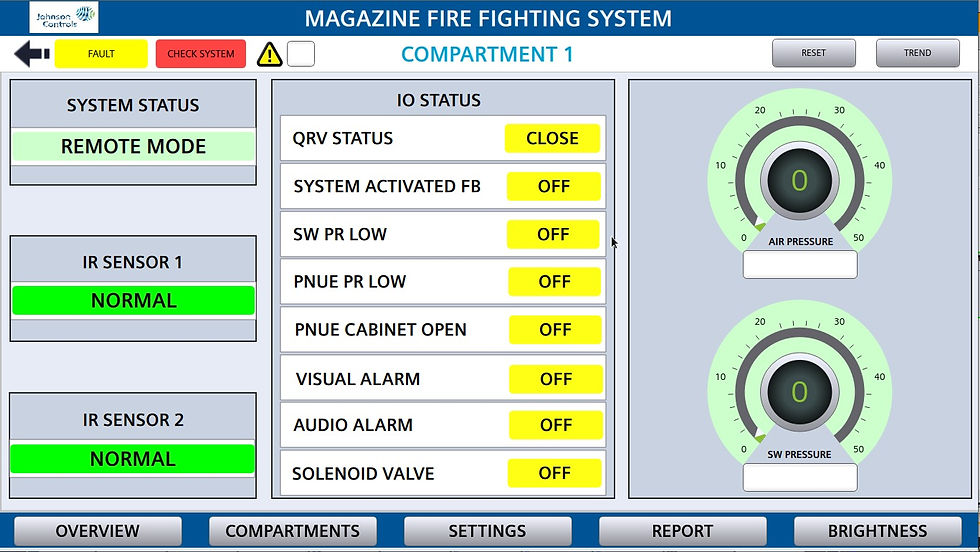
Five screens navigable from the front panel: Overview (all compartments at a glance), Compartment Detail (per-sensor dials and CHECK SENSOR alerts), Settings, Trend (historical logging), and Report (on-demand event reports).
Project Execution
Phase | Activity | Detail |
Phase 1 | Engineering | I/O list development, PLC architecture, network topology, panel GA drawings, and control philosophy documentation for all operating modes — remote, local, emergency, and maintenance. |
Phase 2 | Programming | Full TIA Portal programme: sensor acquisition, fault detection, alarm management, CHECK SENSOR logic, QRV sequencing, Modbus communication. HMI screens: Overview, Compartment, Settings, Trend, Report. |
Phase 3 | Fabrication | 88 panels fabricated at Goose Engineering Centre, Pune. DCHQ panels: S7-1500, ET 200SP, MTP 1500 HMI, Schneider MCBs, SMPS, UPS, MRP switches. LCP panels: 22–24 indicator lamps, pushbuttons, key selector, buzzer — all to standard BOM. |
Phase 4 | FAT | 100% panel-level Factory Acceptance Testing: all I/O points exercised, alarm sequences verified, CHECK SENSOR logic tested, MRP ring failover confirmed, UPS switchover tested, HMI navigation checked before dispatch. |
Phase 5 | Commissioning | Vessel-by-vessel site commissioning: sensor scaling verification with field instruments, network health check, operator training, and as-built documentation produced per vessel. |
Results & Outcomes
88 Panels Delivered | 100% FAT Pass Rate | 11 Ships Operational | 0 Post-Commissioning Failures |
The MFFS is operational across all 11 vessels — three-tier alarm escalation (Check Sensor → Pre-Alarm → Activated), LCP annunciation per compartment, and full operator control from the DCHQ panel. Heater-controlled JBs, MRP redundancy, and UPS-backed power have ensured zero failures since commissioning.

Key Takeaways
Safety-critical, life-safety automation; not just process control
88 panels at consistent quality, delivered from a single engineering centre
Deep Siemens SI expertise: S7-1500, ET 200SP, TIA Portal, MTP HMI; end-to-end
Marine and defence experience: harsh environment, redundant networks, UPS design
Full in-house scope: engineering, fabrication, FAT, and commissioning under one roof
88 panels. 11 ships. 100% FAT pass rate. Zero post-commissioning failures.
About Goose Industrial Solutions
Goose Industrial Solutions is an authorised Siemens System Integrator delivering end-to-end industrial automation solutions across sectors including dairy, beverage, food processing, marine, and defence. With 40+ successful projects, Goose combines engineering expertise with proven Siemens technologies to optimise performance, efficiency, and reliability.
Get in touch with Goose Industrial Solutions to transform your operations with smarter automation.


Comments